
Fitness Routine for Beginners at Home: A Simple Weekly Plan
 BodyPact Team
A fitness routine for beginners at home doesn’t have to be complicated. You can start with two short strength workouts, three days of walking or other easy cardio, and two recovery days. Most sessions take just 10–25 minutes, and you won’t need expensive equipment.
Below, you’ll find a seven-day schedule, instructions for each exercise, and a four-week progression plan. More importantly, you’ll learn how to adjust the routine when an exercise feels too difficult or your schedule gets busy.
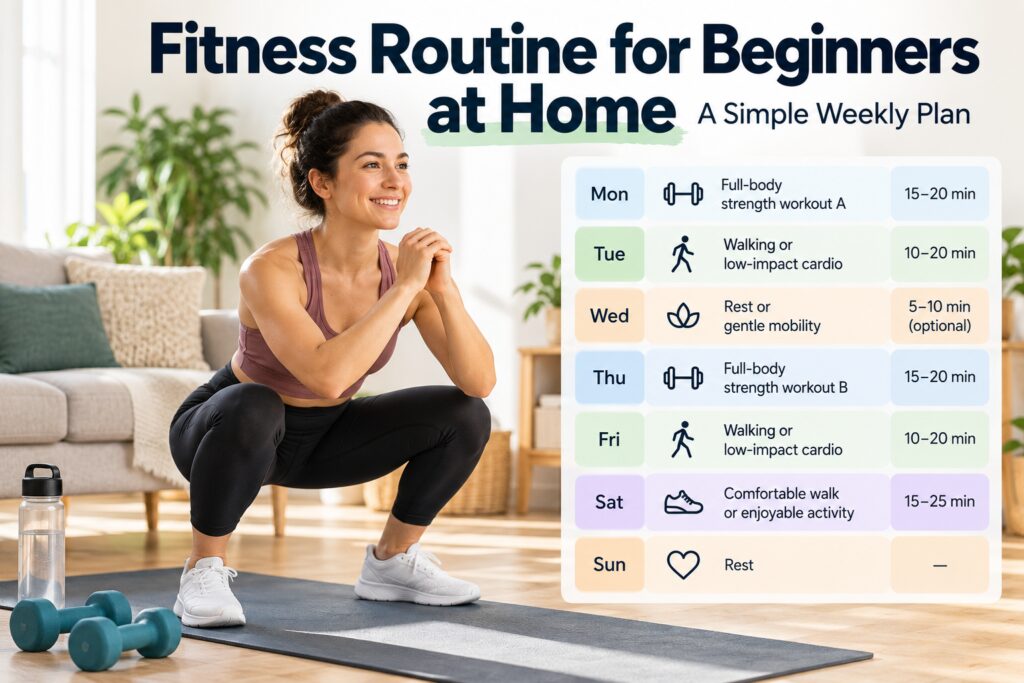
Fitness Routine for Beginners at Home: Your Weekly Schedule
When you’re new to exercise, consistency matters more than intensity. Therefore, your first week should include manageable sessions rather than demanding daily workouts.
Here’s a practical schedule for someone who is currently inactive or returning after a long break.
| Day | Activity | Duration |
|---|---|---|
| Monday | Full-body strength workout A | 15–20 minutes |
| Tuesday | Walking or low-impact cardio | 10–20 minutes |
| Wednesday | Rest or gentle mobility | 5–10 minutes optional |
| Thursday | Full-body strength workout B | 15–20 minutes |
| Friday | Walking or low-impact cardio | 10–20 minutes |
| Saturday | Comfortable walk or enjoyable activity | 15–25 minutes |
| Sunday | Rest | — |
You can rearrange these days to suit your schedule. However, try to leave at least one recovery day between strength workouts.
According to the American Heart Association’s physical activity recommendations, adults should work toward at least 150 minutes of moderate-intensity aerobic activity each week, plus muscle-strengthening activity on at least two days.
That doesn’t mean you must reach those numbers immediately. Instead, start with an amount you can manage and gradually build toward the recommendations.
If five activity days feel overwhelming, begin with Monday, Thursday, and one walking day. Once that becomes comfortable, add another session.
What You Need Before Your First Home Workout
You don’t need to turn your living room into a gym. In fact, most exercises in this plan use your body weight.
Prepare the following:
- A sturdy chair that won’t slide or roll
- A clear wall for standing push-ups
- Comfortable clothing and supportive footwear
- Enough floor space to move safely
- An optional exercise mat
If you’re considering buying dumbbells or resistance bands, read our fitness equipment for beginners guide. It explains which items are useful and which purchases can wait.
Start With a Short Warm-Up
Before each strength workout, spend three to five minutes preparing your body for movement.
First, march gently in place for about a minute. Next, roll your shoulders, take a few sideways steps, and practice five easy chair sit-to-stands.
You should feel a little warmer afterward, but not exhausted. If you’re already breathing heavily, slow down before starting the main workout.
Monday: Full-Body Strength Workout A
Your first strength session introduces four simple movements. Together, they work your legs, chest, hips, and calves.
| Exercise | Repetitions | Sets |
|---|---|---|
| Chair sit-to-stands | 8 | 1–2 |
| Wall push-ups | 8 | 1–2 |
| Glute bridges | 8 | 1–2 |
| Standing calf raises | 10 | 1–2 |
Start with one set of each exercise. Between movements, rest for approximately 45–60 seconds or longer if necessary.
If the first round feels comfortable and your technique remains controlled, you can complete a second. Otherwise, one round is enough for your first session.
Chair Sit-to-Stands
Sit on a stable chair with your feet flat on the floor. Then lean forward slightly, stand up, and slowly lower yourself back into the seat.
Keep your knees moving in the same general direction as your toes. Also, avoid dropping into the chair at the end of each repetition.
Make it easier: Use the chair’s stable armrests for assistance.
Make it harder: Stand without using your hands and lower yourself more slowly.
Wall Push-Ups
Stand facing a wall and place your hands at approximately chest height.
Next, bend your elbows to bring your chest toward the wall. Push back until your arms return to the starting position.
Keep your body reasonably straight throughout the movement.
Make it easier: Stand closer to the wall.
Make it harder: Move your feet slightly farther away while maintaining control.
For a visual demonstration, the NHS Strength and Flex exercise videos include a standing press-up tutorial.
Glute Bridges
Lie on your back with your knees bent and your feet flat on the floor.
Gently lift your hips, pause briefly, and lower them again. As you move, avoid arching your lower back excessively.
Make it easier: Lift your hips through a smaller, comfortable range.
If getting onto the floor is difficult, skip this exercise and complete another set of chair sit-to-stands instead.
Standing Calf Raises
Stand beside a stable support with your feet approximately hip-width apart.
Slowly lift your heels, pause, and lower them again. Rather than bouncing, focus on smooth movement.
Make it easier: Hold the support with both hands.
Make it harder: Pause for two seconds at the top of each repetition.
Once you’ve finished all four exercises, walk slowly for a minute or two before ending the session.
Tuesday: Easy Cardio at Home
Walking is a practical way to begin cardiovascular exercise. You can walk outdoors, move around your home, or march in place when the weather is poor.
Start with 10–20 minutes at a comfortable pace. However, if that feels difficult, divide the activity into two shorter sessions.
For example, you might walk for seven minutes after breakfast and another seven minutes after dinner.
At first, don’t worry about your speed or distance. Instead, focus on moving comfortably and finishing the session without feeling overwhelmed.
As your endurance improves, you can gradually increase your pace. During moderate-intensity walking, you should generally be able to talk, although singing would be difficult.
The American Heart Association also offers practical advice for becoming more active, including ways to incorporate movement into everyday life.
Wednesday: Rest or Gentle Mobility
Recovery is an important part of a home fitness routine for beginners. After all, your body needs time to adapt to unfamiliar movements.
You can take the entire day off. Alternatively, spend five to ten minutes doing gentle mobility exercises.
Try a few of these movements:
- Shoulder circles
- Comfortable neck movements
- Slow ankle circles
- Gentle standing torso rotations
- A relaxed walk around your home
Move slowly and stay within a comfortable range. There’s no need to force a stretch or hold an uncomfortable position.
If your legs still feel tired after Monday, choose rest instead. You’ll have another strength session tomorrow.
Thursday: Full-Body Strength Workout B
Today, you’ll practice a different combination of exercises. As a result, you’ll work on leg strength, upper-body pushing, trunk control, and balance.
| Exercise | Repetitions | Sets |
|---|---|---|
| Supported mini-squats | 8 | 1–2 |
| Wall push-ups | 8 | 1–2 |
| Bird dogs | 6 per side | 1–2 |
| Standing side leg raises | 8 per side | 1–2 |
Begin with the same three-to-five-minute warm-up you used on Monday.
Then complete one round of the exercises, resting whenever necessary. A second round is optional.
Supported Mini-Squats
Stand with your feet comfortably apart and hold a secure support if needed.
Bend your knees slightly while moving your hips backward. Then return to standing.
You don’t need to squat deeply. In fact, a small, controlled movement is a sensible starting point.
Wall Push-Ups
Repeat the wall push-ups from Monday.
If eight repetitions felt difficult earlier in the week, stand closer to the wall. On the other hand, if they felt easy, keep the same position and focus on slower repetitions.
There’s no need to increase the difficulty every time you exercise.
Bird Dogs
Begin on your hands and knees.
Extend one leg behind you while keeping your trunk steady. Afterward, return to the starting position and switch sides.
Once you’re comfortable, try extending the opposite arm at the same time.
Alternative: If kneeling is uncomfortable, perform supported standing marches instead.
Standing Side Leg Raises
Stand upright beside a sturdy chair or wall.
Slowly move one leg out to the side without leaning your upper body. Then bring it back and repeat.
Keep the movement small and controlled. If necessary, hold the support with both hands.
For additional examples of supported movements, the NHS balance exercises guide demonstrates exercises that use a stable chair or wall.
What About Exercises for Your Back?
These introductory workouts focus on movements that require little or no equipment. However, a more complete strength routine should eventually include pulling exercises for the upper back.
Once you’re comfortable with the basics, you could add a light resistance-band row. Make sure the band is securely anchored and follow its safety instructions.
For now, there’s no need to buy resistance bands before completing your first week.
Friday and Saturday: Build Your Cardio Habit
On Friday, repeat Tuesday’s walking session.
If you comfortably completed 15 minutes, you might try 17–20 minutes. However, if the previous walk felt demanding, repeat the same duration or shorten it.
Saturday gives you more flexibility.
For example, you could go for a relaxed walk, try gentle dancing, or ride a bicycle at a comfortable pace. Choose an activity that suits your ability and that you genuinely enjoy.
You can also divide your activity into smaller sessions. A ten-minute walk in the morning and another after lunch may be easier to schedule than one continuous workout.
Ultimately, the best activity is one you’re willing and able to repeat.
Sunday: Rest and Prepare for Next Week
Sunday is your recovery day. You don’t need to complete another workout just because you have free time.
Instead, take a few minutes to prepare for the coming week.
Decide when you’ll complete your two strength sessions and where walking fits into your schedule.
For example, you might plan strength workouts on Monday and Thursday mornings, followed by walks after lunch on Tuesday and Friday.
If you missed a workout this week, don’t try to compensate by doubling the next one. Simply return to your normal schedule.
How to Progress Your Home Fitness Routine Over Four Weeks
During your first month, the main goal is to become comfortable with regular movement. Therefore, progression should be gradual rather than automatic.
Here’s an example of how you could build on the first week’s routine.
| Week | Strength Workouts | Cardio Sessions | Main Focus |
|---|---|---|---|
| Week 1 | 1 set per exercise | 10–20 minutes | Learn the movements |
| Week 2 | 1–2 sets if comfortable | Maintain or add a few minutes | Improve consistency |
| Week 3 | Up to 2 sets | 15–25 minutes if ready | Build endurance |
| Week 4 | Maintain or progress slightly | Increase gradually | Establish a repeatable habit |
These are suggested progressions, not strict deadlines.
If Week 2 still feels challenging, repeat it. Likewise, if an exercise causes discomfort or your technique deteriorates, reduce the difficulty instead of adding more repetitions.
A Practical Example of Progression
Suppose you can complete eight chair sit-to-stands without assistance.
During the following week, try ten repetitions while keeping the rest of your workout unchanged.
Once ten repetitions feel comfortable, you might add a second set. However, there’s no need to increase your walking time and every strength exercise simultaneously.
For a longer program after your first month, explore our 12 week fitness plan for beginners.
How Hard Should a Beginner Home Workout Feel?
Your first strength workouts should feel manageable, even when the final repetitions require some effort.
You should still be able to control each movement. If your technique breaks down, stop the set or choose an easier variation.
For cardio, begin at a pace where you can speak comfortably. Then, as your fitness improves, gradually work toward more moderate-intensity activity.
Importantly, feeling exhausted isn’t proof that a workout was effective.
A session that leaves you able to recover and exercise again later in the week is usually a better starting point than one that causes excessive fatigue.
A 10-Minute Home Workout for Busy Days
Some days, a 20-minute workout won’t fit your schedule. Fortunately, you can still complete a shorter session.
Try this ten-minute option:
- Minutes 1–2: March gently in place and warm up.
- Minutes 3–4: Perform chair sit-to-stands, resting as needed.
- Minutes 5–6: Perform wall push-ups, resting as needed.
- Minutes 7–8: Perform standing calf raises or supported side leg raises.
- Minutes 9–10: Walk slowly and allow your breathing to settle.
You don’t need to exercise continuously throughout each block. Instead, complete a comfortable number of repetitions and rest when necessary.
Although this shorter session doesn’t replace every planned workout, it can help you maintain your routine during busy weeks.
Common Mistakes Beginners Make With Home Workouts
Starting With Too Much Exercise
A demanding daily schedule may look motivating at first. However, it can quickly become difficult to maintain.
Instead, begin with a small number of manageable sessions. Once they become part of your routine, gradually increase your activity.
Progressing Too Quickly
Adding repetitions, sets, and resistance all at once makes it difficult to judge how your body responds.
For that reason, change one variable at a time.
For example, increase chair sit-to-stands from eight to ten repetitions while keeping the rest of your workout unchanged.
Ignoring Exercise Technique
Moving slowly and comfortably matters more than completing a particular number of repetitions.
If you lose control of a movement, stop the set. Alternatively, choose an easier variation that allows you to maintain good technique.
Skipping Recovery
Strength training challenges your muscles, so recovery time matters.
That’s why this weekly schedule separates the two strength workouts. Meanwhile, the walking sessions can remain comfortable rather than demanding.
Giving Up After Missing a Workout
Missing one session doesn’t mean your routine has failed.
Instead of compensating with an unusually difficult workout, return to your schedule or complete a shorter session when appropriate.
When Should You Make Your Home Workout Harder?
Consider increasing the difficulty when you can complete your current exercises with consistent technique and recover comfortably between sessions.
You have several options:
- Add one or two repetitions to an exercise.
- Complete a second set.
- Increase your walking time by a few minutes.
- Try a slightly more challenging exercise variation.
- Introduce light resistance equipment.
However, you don’t need to make every exercise harder at once.
For example, if wall push-ups feel easy but mini-squats remain challenging, progress the push-ups and leave the squats unchanged.
This approach makes it easier to understand which changes work for you.
What Should You Track During Your First Month?
You don’t need a complicated fitness tracker to monitor your progress.
Instead, start by recording three things:
- Which workouts you completed
- How many sets or repetitions you performed
- How difficult each session felt
For example, your notes might look like this:
Monday: Workout A. One set of each exercise. Wall push-ups felt easy, but chair sit-to-stands were moderately difficult.
After a few weeks, compare your notes.
Perhaps you can now complete ten chair sit-to-stands instead of eight. Or maybe a 15-minute walk feels easier than it did during your first week.
These are useful signs of progress, even if your weight or appearance hasn’t changed.
When to Get Professional Guidance
This general routine is intended for adults who can safely participate in light physical activity.
If you have a medical condition, recent injury or surgery, significant joint problems, or other concerns about exercise safety, speak with a qualified healthcare professional before starting or adapting the plan.
Likewise, stop an exercise if it causes pain or makes you feel unwell. The NHS Strength and Flex guidance includes advice on exercising safely and seeking medical guidance when appropriate.
Seek urgent medical care if exercise causes chest pain, fainting, or severe unexpected breathlessness.
Frequently Asked Questions
Can I Do a Beginner Home Workout Every Day?
You can include comfortable walking or gentle movement on many days. However, you don’t need to repeat the full strength routine daily. This plan includes recovery time between strength sessions.
Is 15 Minutes of Exercise Enough for a Beginner?
Yes, 15 minutes can be a useful starting session, especially if you’re currently inactive. As your endurance improves, gradually increase your activity toward recommended weekly levels.
Can I Get Stronger Without Dumbbells?
Yes. Bodyweight exercises such as chair sit-to-stands and wall push-ups can introduce your muscles to resistance training. Later, you can add equipment to continue progressing.
What if I Can’t Complete All the Exercises?
Start with fewer repetitions or choose easier variations. Alternatively, complete only two or three exercises until the routine feels manageable.
How Long Should I Follow This Routine?
Try following the schedule for approximately four weeks, adjusting the workload to your ability. Afterward, you can progress the same exercises or move to a more comprehensive training program.
Start With Your First Workout
Your first week doesn’t need to be impressive. It needs to be manageable.
Start by choosing two days for strength training. Then add a few comfortable walks and leave enough time for recovery.
If a workout feels too difficult, simplify it. If you miss a day, return to the schedule without trying to catch up.
Over time, you’ll learn which exercises work for you, how much activity feels comfortable, and when you’re ready for a greater challenge.
For now, choose a day for your first workout and prepare your exercise space. That’s enough to get started.

BodyPact Team
BodyPact author writing about simple food and movement habits without pressure.
Not sure where to start?
Answer 3 questions and get your first simple step for food and movement.