
12 Week Fitness Plan for Beginners: Build a Routine That Lasts
 BodyPact Team
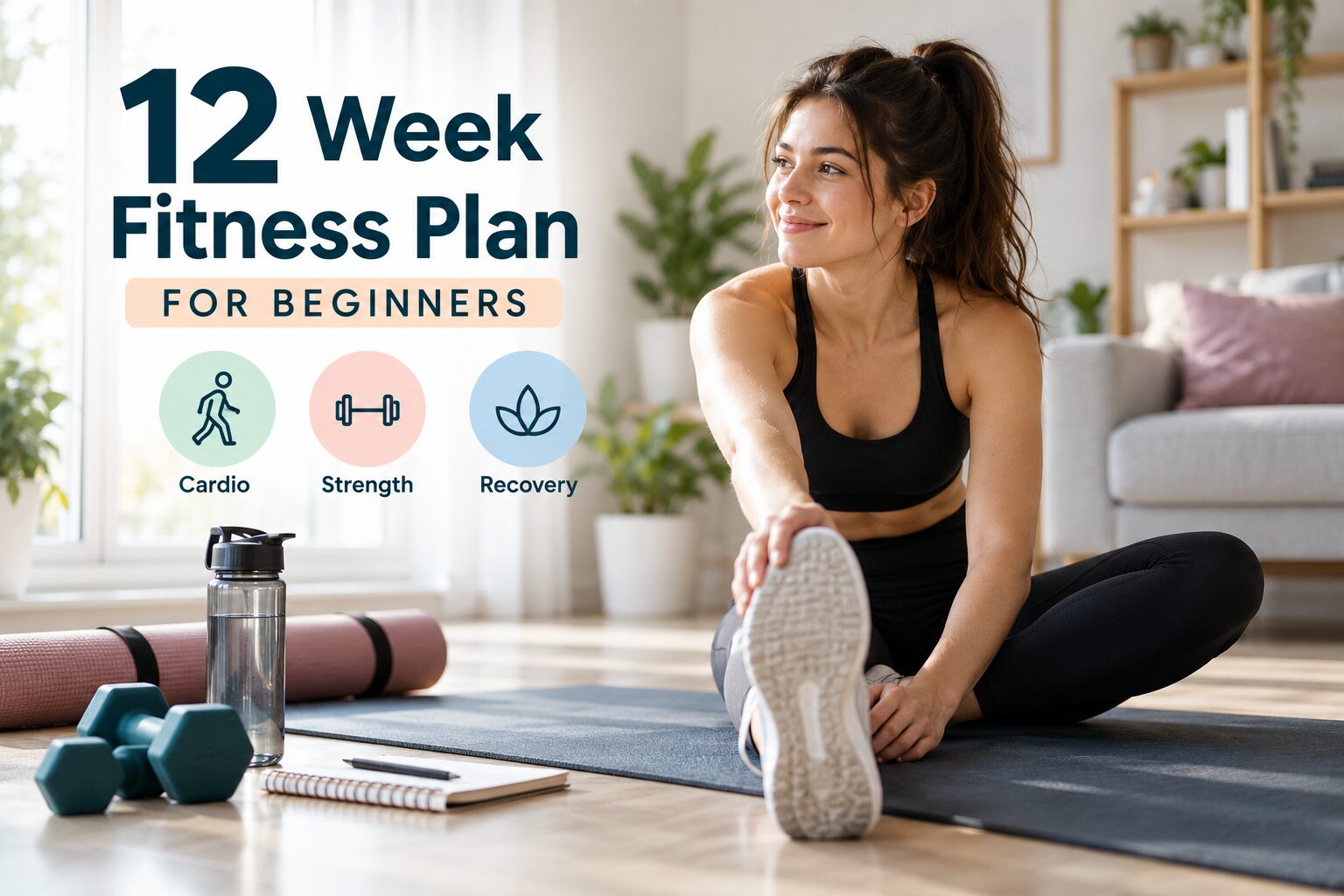
A 12 week fitness plan for beginners gives you enough time to start exercising without trying to change everything in the first week. Instead, this plan begins with short sessions and gradually builds toward a balanced fitness routine for beginners that includes cardio, strength training, and recovery.
You don’t need a gym, expensive equipment, or previous training experience. First, you’ll start with walking and basic strength exercises. Then, as those sessions become more manageable, you’ll gradually increase your activity.
How This 12 Week Fitness Plan for Beginners Works
The plan is divided into three four-week phases.
| Phase | Weeks | Main goal |
|---|---|---|
| Start | 1–4 | Establish workout days and learn basic exercises |
| Build | 5–8 | Increase activity and strength gradually |
| Continue | 9–12 | Develop a routine you can maintain |
The week numbers provide structure, but they aren’t deadlines. If a week still feels difficult, repeat it rather than progressing simply because seven days have passed.
This gradual approach also fits the Physical Activity Guidelines for Americans, which recommend that inactive adults begin with smaller amounts of activity and gradually work toward higher levels.
Weeks 1–4: Build the Routine First
During the first month, your priority isn’t to see how much exercise you can tolerate. Instead, focus on making exercise a predictable part of your week.
Week 1
Start with three active days:
- Monday: 15-minute brisk walk
- Wednesday: short full-body strength workout
- Saturday: 20-minute walk
For your first beginner strength workout, use these basic exercises:
- Chair squat — 8–10 repetitions
- Wall push-up — 8–10 repetitions
- Glute bridge — 8–10 repetitions
- Resistance-band row — 8–10 repetitions
- Supported plank — 10–20 seconds
Complete one set of each exercise. At this point, you’re learning the movements and establishing a training day, so don’t worry if the workout feels short.
Week 2
Keep the same three-session schedule. However, if the walks felt comfortable during week 1, add about five minutes to one or both of them.
For strength training, repeat the same exercises. Repetition gives you a chance to improve your technique and notice when movements begin to feel easier.
Week 3
Now add a second strength session.
| Day | Activity |
|---|---|
| Monday | 20–25 minute brisk walk |
| Tuesday | Full-body strength |
| Wednesday | Rest |
| Thursday | 20-minute walk |
| Friday | Full-body strength |
| Saturday | Optional easy walk |
| Sunday | Rest |
As a result, you now have two strength workouts while still leaving recovery time between them.
Week 4
Instead of immediately adding more exercise, keep the week 3 schedule.
Then review what’s actually happening:
- Which sessions did you consistently complete?
- Which workout did you tend to skip?
- Are the exercises becoming easier?
- Are you recovering comfortably between workouts?
- Do these training days fit your normal schedule?
For example, if Friday workouts keep getting missed because Friday is always busy, move the workout to another day. A useful fitness training plan for beginners should fit your real schedule rather than require you to reorganize your entire life around exercise.
Why You Don’t Need to Rush the First Month
There’s another reason to keep the first weeks simple: routines take time to become familiar.
A 2024 systematic review and meta-analysis of health behavior habit formation examined 20 studies involving 2,601 participants. Among studies that measured time to habit formation, results varied substantially between individuals rather than supporting the idea that everyone develops a habit after the same short period.
Therefore, repeating your schedule isn’t wasted time. You don’t need a completely different workout every week.
Instead, repeating a manageable routine gives you an opportunity to learn the exercises, notice progress, and make training more predictable.
Your Beginner Strength Workout
You can keep the same basic movement patterns throughout the 12 weeks.
| Movement | Start with | Possible progression |
|---|---|---|
| Squat | Chair squat | Bodyweight squat |
| Push | Wall push-up | Incline push-up |
| Pull | Light resistance-band row | Stronger band |
| Hips | Glute bridge | More repetitions or resistance |
| Core | Supported plank | Longer plank variation |
The goal isn’t to collect as many exercises as possible. Instead, focus on becoming more comfortable and capable with a small group of useful movements.
The American College of Sports Medicine’s 2026 resistance-training position stand reviewed evidence on resistance-training prescription in healthy adults. Importantly for beginners, effective resistance training doesn’t need to be unnecessarily complicated.
In addition, ACSM’s practical resistance-training guidance emphasizes consistency and shows that training can use different forms of resistance rather than requiring one particular type of equipment.
So, don’t postpone your first month because you don’t own dumbbells or a gym membership.
Weeks 5–8: Gradually Build Your Base
By week 5, your fitness routine for beginners should feel more familiar. Now you can begin increasing the amount of activity without rebuilding the entire program.
Weeks 5–6
Try this schedule:
- Monday: 25–30 minute brisk walk
- Tuesday: full-body strength
- Wednesday: rest or easy walk
- Thursday: 25–30 minutes of moderate cardio
- Friday: full-body strength
- Saturday: 30-minute walk
- Sunday: rest
Walking is used throughout this plan because it’s accessible and easy to adjust. However, it isn’t mandatory.
For example, you could replace a walking session with cycling, swimming, an elliptical, or another aerobic activity that suits you.
How to Progress Your Strength Workouts
Progress doesn’t mean changing every exercise.
Suppose you started with one set of eight chair squats. Several weeks later, you can perform two sets of twelve with good control, and the exercise feels noticeably easier.
At that point, you could:
- move from a chair squat toward an unsupported squat;
- add a small amount of resistance;
- perform a few more repetitions;
- slow the movement down.
Choose one change first. Then see how your body responds before changing something else.
The same principle applies to other exercises. For instance, when wall push-ups become easy, you can progress to push-ups against a stable kitchen counter or another elevated surface.
That gives you an intermediate step instead of forcing you to move directly from wall push-ups to floor push-ups.
Weeks 7–8: Don’t Add Exercise Automatically
You’ve now reached the middle of the 12 week fitness plan for beginners. However, that doesn’t automatically mean you need another workout day.
First, look at the previous two weeks.
If you completed most of your workouts, recovered well, and your current sessions are becoming easier, make a modest progression. On the other hand, if you’re regularly skipping sessions because the schedule is already difficult to maintain, adding another workout probably isn’t the solution.
Instead, adjust the schedule.
For example, four realistic workouts are more useful than six planned workouts that you rarely complete.
How Hard Should Your Cardio Feel?
You don’t need to run for this plan to work. For many people, brisk walking can provide moderate-intensity aerobic activity depending on their current fitness and pace.
The current Physical Activity Guidelines for Americans recommend that adults work toward 150–300 minutes of moderate-intensity aerobic activity per week, together with muscle-strengthening activity on at least two days.
However, that’s a target to work toward rather than a requirement for your first week.
In fact, the government’s Move Your Way guidance specifically encourages people who are getting started to build toward the recommended amount over time.
That’s why this fitness workout routine for beginners starts below the full weekly recommendation.
Weeks 9–12: Turn the Plan Into Your Normal Week
During the final month, the purpose of the plan begins to change.
Instead of asking, “How do I finish this program?” start asking, “Could I keep doing something like this?”
Weeks 9–10
A practical week might look like this:
| Day | Activity |
|---|---|
| Monday | 30-minute brisk walk |
| Tuesday | Full-body strength |
| Wednesday | 20–30 minutes of easy or moderate cardio |
| Thursday | Rest |
| Friday | Full-body strength |
| Saturday | 30–45 minutes of moderate cardio |
| Sunday | Rest or easy walk |
The exact days aren’t important. Therefore, move them around if another schedule fits your life better.
What matters more is maintaining a useful combination of aerobic activity, strength training, and recovery.
Weeks 11–12
At this point, don’t automatically make the final two weeks harder. Instead, use them to test whether your current schedule is sustainable.
For instance, Tuesday and Friday may work perfectly for strength training. If Saturday cardio keeps getting skipped because your weekends are unpredictable, move it to another day. You may also discover that four shorter walks fit your schedule better than two longer sessions.
By week 12, you should know much more about what type of routine you can realistically continue.
How to Know When You’re Ready to Progress
You don’t need to increase your workout every week. Instead, look for practical signs that the current level is becoming manageable.
For example, a strength exercise may be ready to progress when you can complete the planned sets with controlled technique and it consistently feels easier than before.
Likewise, a cardio session may be ready to progress when the same walk requires noticeably less effort.
At that point, change one variable.
For cardio, you could:
- walk five minutes longer;
- increase your pace slightly;
- choose a slightly more demanding route.
For strength training, you could:
- add repetitions;
- add a set;
- use slightly more resistance;
- choose a harder version of the exercise.
However, don’t increase all of these variables at the same time.
What Should You Track?
You don’t need an elaborate spreadsheet to follow a 12 week fitness plan for beginners.
Instead, record a few basic details after each workout:
- whether you completed it;
- cardio duration;
- strength exercises;
- sets and repetitions;
- resistance used, if applicable;
- how difficult the session felt.
Over time, this creates a simple record of what you’re actually doing.
For example:
Week 2: wall push-ups — 1 × 8
Week 6: wall push-ups — 2 × 10
Week 10: incline push-ups — 2 × 8
Consequently, you can see progress that wouldn’t necessarily appear on a scale.
What If You Miss a Workout?
Missing one workout doesn’t require a special response.
Simply continue with your schedule.
In particular, don’t double your next workout to compensate for the missed session. If you miss several workouts, return at a level that feels appropriate rather than immediately jumping back into the hardest week you’ve completed.
A missed workout doesn’t erase the work you’ve already done.
What If You Miss an Entire Week?
First, consider why the interruption happened.
If work, travel, or family responsibilities disrupted your schedule, you may be able to resume around the level you previously completed.
However, if you’ve been ill or haven’t exercised for a longer period, returning with less volume or intensity may be more appropriate.
Either way, you don’t automatically need to restart at week 1.
The important skill is learning how to return to your routine. After all, interruptions won’t stop happening just because the 12-week program ends.
What Equipment Do You Actually Need?
Very little.
For the first weeks, you can do most of the plan with:
- comfortable shoes;
- a chair;
- some floor space;
- your body weight.
A resistance band is a useful addition because it makes pulling exercises easier to perform at home. Later, dumbbells can also make progression easier when bodyweight movements no longer provide enough resistance.
However, don’t turn buying fitness equipment into the first stage of getting fit.
Start exercising first. After several weeks, you’ll have a much better idea of what equipment would actually improve your workouts.
What Should You Do After Week 12?
First, compare week 12 with week 1.
Don’t look only at body weight.
Instead, ask:
- Can you walk longer?
- Does the same walking pace feel easier?
- Can you perform more repetitions?
- Have you progressed to harder exercise variations?
- Are you completing workouts more consistently?
- Do you know which training days fit your schedule?
Next, decide what you want to improve.
You might continue the same structure while gradually increasing your strength work. Alternatively, you could begin a structured walking or running plan or start training at a gym. However, if your current routine is working well, there’s no reason you can’t simply continue it.
If establishing the habit is still your biggest challenge, our fitness for beginners guide explains the broader process of starting exercise and staying consistent.
When a General 12-Week Plan Isn’t Enough
This plan provides general fitness guidance for adults rather than individualized medical or rehabilitation advice.
If you have an injury, significant mobility limitation, a medical condition that affects exercise, are pregnant, take medication that affects your response to exercise, or have been advised to restrict physical activity, your appropriate starting point may be different.
Similarly, concerning symptoms during exercise, such as chest pain or fainting, aren’t something to push through simply to complete the day’s workout.
What Success Looks Like After 12 Weeks
You don’t need to finish this 12 week fitness plan for beginners able to run a race or lift a particular amount of weight.
A more useful result is having a routine you understand and can repeat.
Ideally, you now exercise more regularly, know your basic strength exercises, and can handle more activity than when you started. In addition, you should have a better idea of when to progress, when to repeat a week, and which training days work best for you.
Most importantly, you have a schedule that can continue into week 13.
FAQ
Is 12 weeks enough to improve fitness?
Twelve weeks gives you time to establish regular activity and gradually progress your workouts. However, the amount of improvement varies depending on your starting point, consistency, exercise choices, recovery, and other individual factors.
How many days per week should a beginner exercise?
There isn’t one required number. This plan starts with three active days and gradually develops toward regular aerobic activity plus two weekly strength sessions. Therefore, someone who is currently inactive doesn’t need to begin with the final schedule.
Can I do the entire plan at home?
Yes. The strength exercises can be performed with body weight and optional resistance bands or dumbbells. In addition, walking can provide much of the aerobic activity, so a gym isn’t required.
What if I’m not ready for the next week?
Repeat your current week. Progress when the workload becomes manageable rather than simply because the calendar says you should move on.
Do I need to work out every day?
No. Rest and lighter days are deliberately included in this fitness training plan for beginners. As a result, you can build activity while still leaving time for recovery.

BodyPact Team
BodyPact author writing about simple food and movement habits without pressure.
Not sure where to start?
Answer 3 questions and get your first simple step for food and movement.