
Fitness Advice for Beginners: How to Start Without Overdoing It
 BodyPact Team
Starting to exercise can feel more complicated than it needs to be. This fitness advice for beginners will help you build a simple routine without trying to change everything at once. You can start with manageable workouts and gradually increase your activity as your fitness improves.
The basic idea is simple: do an amount of exercise you can realistically repeat. You do not need to train every day or push yourself to exhaustion. Start with manageable sessions, combine aerobic activity with basic strength training, and give yourself enough time to recover.
Fitness Advice for Beginners: Start With a Manageable Amount
If you have been mostly inactive, jumping straight into five or six workouts per week is rarely necessary.
A better starting point is to create a schedule that fits your current fitness level and your normal week. That might mean two short strength sessions and several walks rather than a demanding daily program.
The CDC’s physical activity guidelines for adults recommend working toward at least 150 minutes of moderate-intensity activity per week and muscle-strengthening activity on at least two days.
That is a useful target, not a requirement you have to reach during your first week.
The CDC also notes that some physical activity is better than none. If 150 minutes feels far beyond your current level, start with less and build up.
| Your current activity | A practical starting point |
|---|---|
| Mostly inactive | 10–20 minute walks several times per week |
| Walking regularly | Add two short strength workouts |
| Occasionally exercising | Establish regular workout days |
| Returning after a long break | Start below your previous training level |
The goal during your first few weeks is to create something repeatable.
If consistency is the part you struggle with most, read our fitness for beginners guide for a broader look at starting exercise and building a routine you can maintain.
Build Your Week Around Cardio and Strength
A fitness routine for beginners does not need dozens of different exercises or specialized workouts.
Two basic forms of exercise cover much of what a beginner needs: aerobic activity and strength training.
Walking is one of the easiest ways to introduce aerobic activity. It requires little preparation, you can adjust the pace and duration easily, and brisk walking can count as moderate-intensity physical activity.
Strength training can be kept equally simple.
The CDC recommends muscle-strengthening activity involving the major muscle groups on at least two days per week.
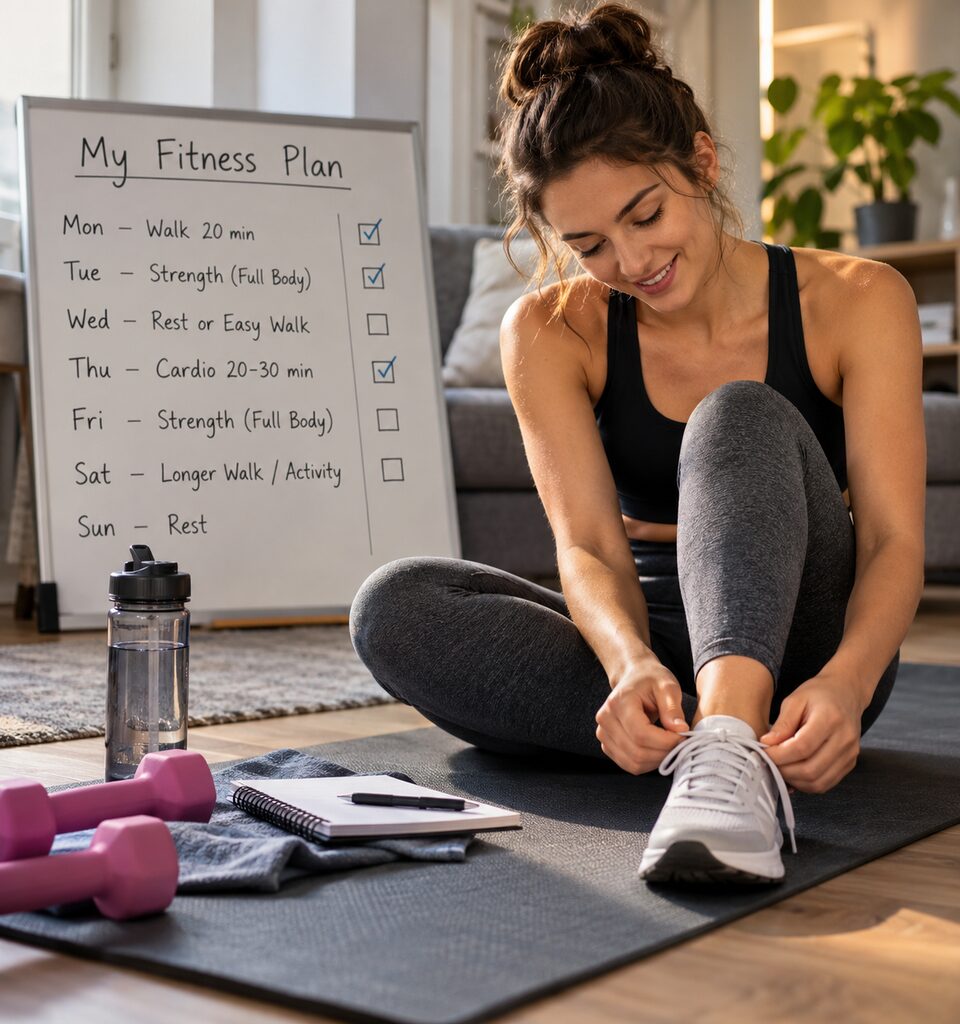
A beginner’s week could look like this:
- Monday: 20-minute brisk walk
- Tuesday: short full-body strength workout
- Wednesday: rest or easy walking
- Thursday: 20–30 minutes of moderate cardio
- Friday: full-body strength workout
- Saturday: longer walk or another activity you enjoy
- Sunday: rest
This is an example rather than a schedule everyone needs to follow.
If four active days are too much right now, start with three. If you already walk regularly, you may be ready for more.
Keep Your First Strength Workouts Simple
You do not need to learn twenty exercises before starting strength training.
A basic beginner workout routine can be built around a handful of movements that train the major muscle groups.
For example:
- Chair squat or bodyweight squat
- Wall or incline push-up
- Resistance-band row
- Glute bridge
- Simple plank variation
Choose versions that allow you to move with control.
If regular push-ups are too difficult, doing them against a wall or elevated surface is not “cheating.” It is simply a variation that matches your current ability.
The same principle applies to other exercises. Start with a version you can perform well and make it harder as you become stronger.
One piece of fitness advice for beginners worth remembering is that complicated equipment is optional. You can build a useful strength routine with bodyweight exercises or simple resistance equipment before deciding whether you need a gym.
The American College of Sports Medicine provides guidance covering resistance training and other forms of physical activity.
For a beginner, consistency matters more than having sophisticated equipment.
Learn What Moderate Exercise Feels Like
A workout does not have to leave you exhausted to be useful.
This is an important part of fitness basics for beginners, because people often associate effective exercise with extreme effort.
During moderate-intensity aerobic activity, your breathing and heart rate increase, but the effort should still be sustainable. The CDC’s guidance on measuring physical activity intensity uses brisk walking as an example of moderate-intensity activity.
You can also use the “talk test” as a simple reference. During moderate activity, you should generally be able to talk, although singing would be difficult.
You do not need to finish every workout completely drained.
Leaving some energy in reserve can make it easier to recover and return for your next planned session.
Increase One Thing at a Time
Your workouts should eventually become more challenging. Otherwise, your body has little reason to adapt.
But progression does not mean changing everything at once.
Suppose you currently walk for 20 minutes three times per week. You could increase those walks to 25 minutes. Alternatively, you could keep the duration the same and walk slightly faster.
You probably don’t need to increase duration, intensity, strength training volume, and weekly workout frequency simultaneously.
The World Health Organization’s physical activity guidelines recommend that inactive people start with small amounts of physical activity and gradually increase frequency, intensity, and duration.
That approach also makes your progress easier to understand. When you change one variable at a time, you can see how your body responds.
Set Fitness Goals for Beginners You Can Actually Measure
“Get fit” is a reasonable ambition, but it is difficult to act on.
Your immediate goals should tell you what to do.
| Vague goal | More useful goal |
|---|---|
| Get in shape | Walk for 25 minutes four times this week |
| Become stronger | Complete two strength workouts each week |
| Exercise more | Train every Monday and Thursday |
| Improve endurance | Add five minutes to one weekly walk |
Notice that these goals focus on behaviors rather than immediate physical results.
You cannot completely control how quickly your weight, appearance, strength, or endurance changes. You can control whether you complete today’s walk.
For your first month, consistency itself is worth tracking.
Don’t Use Soreness to Judge Your Workout
Muscle soreness can happen after unfamiliar exercise, particularly when you are just starting or introduce a new movement.
But more soreness does not automatically mean a better workout.
If every session makes normal movement uncomfortable for several days, your training may be harder than necessary for your current level.
Instead of asking, “Am I sore enough?”, ask whether you can recover in time for your next planned session.
That changes the way you think about exercise. Each workout becomes part of a longer routine rather than an isolated test of how much discomfort you can tolerate.
Rest Days Are Part of Your Routine
Rest is not a sign that your plan has failed.
Another useful piece of fitness advice for beginners is to treat recovery as part of the plan rather than something that interrupts it. Your routine has to coexist with work, family, sleep, stress, and everything else happening during the week.
You can also remain lightly active on days without structured training. An easy walk, for example, does not have to become another formal workout.
Avoid adding training days simply because a plan with six workouts looks more serious than one with three.
The better schedule is the one you can maintain.
Don’t Buy Equipment Until You Know What You Need
Starting a fitness routine can quickly turn into shopping.
A smartwatch, new shoes, dumbbells, resistance bands, exercise mat, supplements, and gym membership can make it feel as though you need an entire setup before your first workout.
You don’t.
For walking, start with comfortable clothing and suitable footwear. For home strength workouts, bodyweight exercises may be enough initially. A resistance band or a pair of dumbbells can expand your options later.
Exercise consistently for a few weeks first.
You’ll then have a much better idea of what equipment would solve an actual problem rather than simply adding another fitness product to your home.
Track What You Do, Not Just What You Weigh
Body weight is only one possible measurement, and day-to-day changes can tell you very little about whether your fitness is improving.
Your training log can be much simpler.
Track things such as:
- number of workouts completed;
- minutes walked;
- exercises performed;
- repetitions completed;
- resistance used;
- how difficult the workout felt.
Imagine that during week one you can perform eight controlled chair squats. Several weeks later, you can comfortably perform twelve.
That’s progress you can see directly.
Tracking also helps prevent guesswork. Instead of wondering whether you are doing more than last month, you can check.
What Should Your First Month Look Like?
Your first month does not need to produce a dramatic transformation.
It should help you understand what kind of exercise schedule works in your life.
| Week | Main focus |
|---|---|
| Week 1 | Establish realistic workout days |
| Week 2 | Repeat the routine and learn the exercises |
| Week 3 | Increase something small if the routine feels manageable |
| Week 4 | Review what worked and what was difficult |
You do not automatically have to progress every week.
If week two still feels challenging, repeat it. If you missed several workouts, adjust the schedule instead of trying to compensate with an unusually hard session.
A sustainable routine can tolerate imperfect weeks.
Know When General Fitness Tips for Beginners Aren’t Enough
General fitness guidance cannot account for every medical condition, injury, medication, pregnancy, disability, or individual limitation.
People with chronic conditions can often still benefit from physical activity, but their appropriate starting point may differ.
The CDC provides separate physical activity guidance for adults with chronic health conditions and disabilities and recommends consulting an appropriate healthcare professional or physical activity specialist when necessary.
Exercise also should not be used to push through potentially serious symptoms. Chest pain, fainting, or other concerning symptoms during physical activity warrant medical attention rather than another attempt at the workout.
Build a Routine You Can Repeat Next Week
The most practical fitness advice for beginners is to progress from what you can do consistently today rather than from what you think a serious workout should look like.
Begin with manageable activity. Include aerobic exercise and strength training. Give yourself time to recover. Track what you actually do and gradually make the routine more challenging when your current workload becomes manageable.
The WHO Guidelines on Physical Activity and Sedentary Behaviour recommend 150–300 minutes of moderate-intensity aerobic activity per week for adults, or the vigorous-intensity equivalent, alongside regular muscle-strengthening activity.
You don’t have to get there immediately.
For someone starting from very little activity, today’s 15-minute walk can be useful precisely because it is achievable.
Do it again. Build from there.
FAQ
How many days a week should a beginner exercise?
There is no single starting number that suits everyone. Your current activity level and the type of exercise matter. The CDC recommends that adults work toward at least 150 minutes of moderate-intensity aerobic activity per week and muscle-strengthening activity on at least two days, but beginners can build toward those targets gradually.
Is walking a good workout for beginners?
Yes. Walking is accessible, easy to adjust to your current ability, and brisk walking can qualify as moderate-intensity aerobic activity. It can be particularly useful for someone moving from a mostly inactive lifestyle toward regular exercise.
Should beginners do cardio or strength training?
You don’t need to choose between them. Current physical activity recommendations include both aerobic and muscle-strengthening activity. A simple weekly routine can contain walking or another form of cardio alongside two strength sessions.
Do beginners need a gym?
No. Walking requires no gym, and many strength exercises can be performed using body weight or simple resistance equipment. A gym becomes useful if its equipment, environment, or classes make it easier for you to train consistently.
How quickly should a beginner increase exercise?
Increase gradually. If your current workouts already feel challenging, continue with them until they become more manageable. When you are ready to progress, changing one variable such as duration, resistance, repetitions, or frequency makes it easier to control the increase.

BodyPact Team
BodyPact author writing about simple food and movement habits without pressure.
Not sure where to start?
Answer 3 questions and get your first simple step for food and movement.